Rowan Spazzoli

Strategist. Lecturer. Consultant

Bad Strategy Part 2/4: Failure to face the problem

Over the next few days I’ll be looking at the “Four Hallmarks of Bad Strategy” from Richard Rumelt’s book Good Strategy/Bad Strategy. Each of these will be linked to a South African example and concluded with a tip to avoid that element of bad strategy.

Note: this post discusses strategy in South African politics. It is not an endorsement for the party being discussed. It is instead an analysis of a shortcoming of their strategy.

The second element of bad strategy that Rumelt highlights is that of “failing to face the problem”. He explains that failure to identify problems means that your strategy is ultimately just a wish list. In order to craft an effective strategy, you need to understand why things haven’t worked well in the past and confront this.

SA Example: The White DA

The Democratic Alliance has been trying everything they can to get into power at a national level. They have made advances in some regards, having won some big local level elections last year.

However, I don’t think that their existing strategy will ever get them in to power at a national level. And the reason is because they are continuously failing to address a fundamental problem:

The DA is perceived to be the party of and for white people

And many South African voters either don’t like this or are scared of what this might mean if the DA get into power. Regardless of whether these fears and dislikes are valid, they are what people perceive, which ultimately direct their voting.

The DA have never tackled this issue head on. Their 2014 National Manifesto and their 2016 Local Manifesto did not contain the word “white” once. They 2016 manifesto used the word “Black” on one ocassion and doesn’t use the word “race” at all.

Some might say that this can’t be the case because now they have a black leader. But I’d argue this has done little to address the problem. They need to find a way to do this if they want to achieve their objectives.


Face the problem


The solution to this pitfall is simple in theory and difficult in practice: face the problem head on. Avoiding it gets you no where. In tackling the underlying problem, it allows for the development of a more effective strategy


Image is from the 2014 elections when everyone was posting pictures with their thumbs and stamps. I was feeling left out so posted this homemade version to social media.

Song of the day: Zedd - Stay
Blog 117/365. Read more about my #365of25 journey here


Subscribe to Blog via Email

Enter your email address to subscribe to this blog and receive notifications of new posts by email.

Bad Strategy Part 1/4: Fluff

Over the next few days I’ll be looking at the “Four Hallmarks of Bad Strategy” from Richard Rumelt’s book Good Strategy/Bad Strategy. Each of these will be linked to a South African example and concluded with a tip to avoid that element of bad strategy


The first element of bad strategy that Rumelt highlights is that of “fluff”. This can be described as the empty, unnecessary words and terms that are used in organisations to describe their strategy.

The example he uses is this. Try guess what type of company it comes from:

Our fundamental strategy is one of customer-centric intermediation” 

Any guesses?

No?

That is the vision statement of a bank in America. And all it says is “we facilitate transactions”. Their strategy is nothing but fluff.

SA Example: UCT’s Fluffy Strategy

In 2016 UCT issued their “Strategic Planning Framework” for 2016-2020. Their very first goal reads as follows:

Goal 1: To forge a new inclusive identity that reflects a more representative profile of students and staff, and the cultures, values, heritage and epistemologies of the diversity of UCT’s staff and students

This is one hell of a fluffy goal. How do we measure it? When do we know we’ve reached it? What exactly does this identity look like?

The goal itself isn’t necessarily bad. In fact, I agree that UCT does need to become more inclusive in a lot of respects. This has particularly become evident over the last few years.

My concern is the strategy and thinking around the goal. They’ve substituted proper strategy for fancy and unnecessary words.

Dodging the Fluff

Writing up fluffy strategies is tempting because we’re able to hide our uncertainty behind meaningless statements. Avoiding doing so is difficult as it requires us to not only avoid the lingo but to also dig deeper into what we’re trying to do.

Therefore, dodging the fluff requires two things. Firstly, use simple language to describe your overarching strategy. But more importantly, be certain of what you’re actually trying to achieve in the first place.


Image is from 2015 when my flatmate and I tried to start a Stikeez business off the back of the Pick N Pay trend. That’s a story for another time 🙂

Song of the day: Tom Rosenthal - Don't Die Curious
Blog 116/365. Read more about my #365of25 journey here


Subscribe to Blog via Email

Enter your email address to subscribe to this blog and receive notifications of new posts by email.

The Friday Shoutout: Phaphama SEDI

In 2013 I joined an organisation that fundamentally changed my life. It was called Siyaya, and it aimed to help entrepreneurs from developing areas in Cape Town by partnering them with students from the university. I worked as a consultant that year and in 2014 was the vice president of the organisation. We then formed a new organisation as an NGO, so that fund raising would be easier. And the new organisation was called Phaphama

Phaphama is in it’s fourth year of operation now. They have trained many entrepreneurs and are expanding to new areas around Cape Town. Some info about them is as follows:

Phaphama Small Enterprise Development Initiative (S.E.D.I) in a Non-Profit Organisation that was established in 2014 by a group of students from the University of Cape Town (UCT), who are committed to promoting leadership, entrepreneurship and small enterprise development in communities in and around Cape Town. Phaphama runs a business development consulting programme in Khayelitsha. The programme runs over 7 months and consists of a series of business management skill sessions and business data collection and analysis. At present eighteen Khayelitsha-based businesses are selected annually to be a part of the project. The programme caters for a diverse array of meaningful local business ventures including, for example, Dlangakana Construction, Soulpix Photography and Lusanda Nail Salon to name a few.

Applications

Applications for Phaphama SEDI are open and close on Monday 26 February. If you join the organisation you’ll be involved in assisting entrepreneurs from Khayelitsha and Philipi with their strategies and business development. It is a fantastic opportunity to experience business in real life, use your position of privilege as UCT students to assist with economic development and to share and grow your networks. There may also be opportunities from non-UCT individuals to get involved

To apply send a cover letter and CV to hmpjul002@myuct.ac.za by 26 February 2018. Contact me if you need more details

Funding

If you want to support Phaphama in other ways, you can do so by helping with funding. This goes towards providing transport for the consultants, organising sessions and other general operations. I’d encourage anyone who can donate to do so at this link.

If you’d like to contribute funding to them directly, please send me an email and let me know (rspazzoli@gmail.com)

Connect

I’ll be joining the Board of Directors of Phaphama this year as a non-executive director. If you want to get in touch, even if it’s just to come and see what they’re up to or link them up to someone, let me know.

Wishing the committee, the consultants and the entrepreneurs all the best for 2018!


Image was taken in 2014 with Siyaya, which became Phaphama/ The entrepreneurs are pictured with certificates for completing the program.

Song of the day: Born Ready (ft Hope Murphy)[Halogen Radio Edit] - Disco Fries
Blog 104/365. Read more about my #365of25 journey here


Subscribe to Blog via Email

Enter your email address to subscribe to this blog and receive notifications of new posts by email.

Lecturing Lesson #5: The Path

Lecturing Lesson #5: The Path

At the start of every lecture, I tell my students the path we’re going to take over the next hour or two. This will usually be accompanied with a slide that has a few bullet points on the major sections of the lecture.

Every time we move to a new section, I’ll bring up the slide again to show them where we are.

And at the end of the lecture, I’ll bring it up one more time to recap where we started and where we have ended up.

Doing this helps provide context to the content and draws a narrative between the major points. It also helps keep students focused (probably cause they know they’re getting closer to being able to leave).

It’s a simple tool, but highly effective in guiding students and making sure they don’t get lost.


Picture is of my friend Charly running in Newlands Forest, taken sometime last year 🙂

P.S. this is the last of the lecturing lessons series (for now) 🙂

Song of the day: Portugal.The Man - Feel it still
Thesis update: had an very helpful meeting with my supervisor :)
Blog 87/365.Read more about my #365of25 journey here

Subscribe to Blog via Email

Enter your email address to subscribe to this blog and receive notifications of new posts by email.

Lecturing Lessons #1

This week I’ll be traveling to Pretoria for my consulting work. It’s going to be quite difficult write full blog posts over that time. So for the next few days I’ll be sharing some tips and lessons I’ve learnt from teaching at UCT. I’ve taught as a tutor, an assistant lecturer and as a lecturer for 4 years. It’s been an incredible journey and I know that this is only the start.

Lecturing Lesson #1: Names

When I used to tutor there would be 30 or 40 students at a time, and I’d usually have two or three classes. And in the strategic thinking course there are around 500 students in total.

Learning names is quite a daunting task. And it’s really easy to get by without learning them. No one expects you to know their name.

But I find it’s one of the easiest ways to connect with students. As soon as you know their names, they tend to be more responsive and attentive, which makes teaching easier.

Obviously I sometimes forget names, but I’ve got two sneaky techniques if I do:

  1. Check the online portal– it might take a bit of scrolling, but all their names and pictures are available on the course tab
  2. Get them to send me an email– promise to follow up if they send an email and then you have their name on record

Again, knowing someone’s name is nothing extraordinary. But in a sea of people, when you’re sometimes just reduced to a student number, it can really make a difference


Image is from the finals of the Oxford Global Challenge in the Nelson Mandela Lecture Theatre at the Saïd Business School

Song of the day: Gorgeous- Taylor Swift
Thesis update: Took the day off :)
Blog 83/365.Read more about my #365of25 journey here

Subscribe to Blog via Email

Enter your email address to subscribe to this blog and receive notifications of new posts by email.

The Friday Shoutout: Uthini

Today I’m starting a new instalment on my blog titled “The Friday Shoutout.” Each week I’ll be highlighting an interesting/awesome person, business or project that I’ve come across. The idea is to spread the word about the exciting things going on the fields of development, entrepreneurship, education, economics, strategy and beyond. If one of the Friday shoutouts catches your attention, send me an email and I’ll connect you with them 🙂

My first Friday Shoutout goes to Uthini, an edutech startup based in Cape Town

Uthini

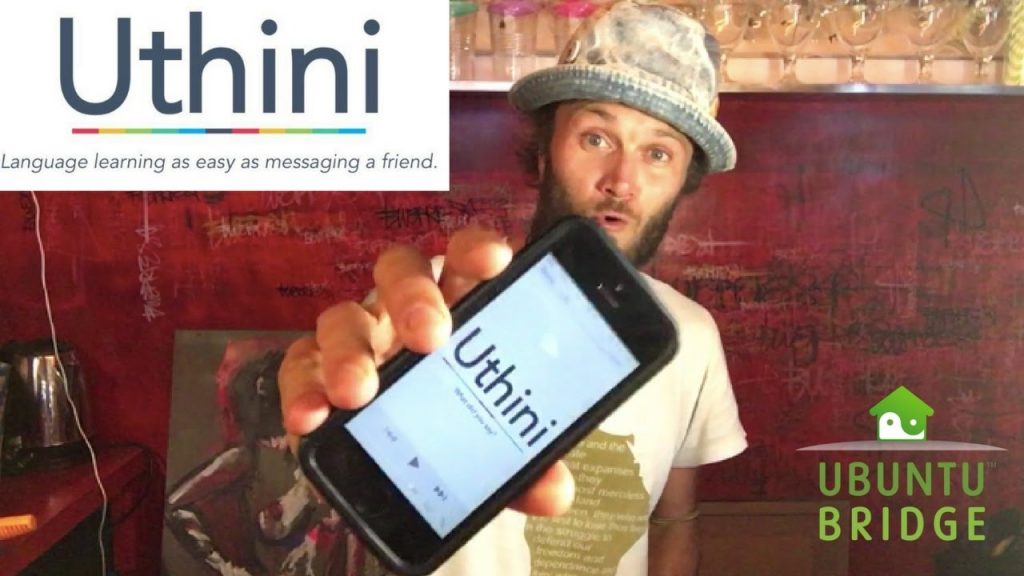
Uthini is an exciting new startup that is making it easier to learn South African languages. Their teaching is done through the Telegram messaging platform (similar to Whatsapp), where a bot and live tutor guide you through the content. Lessons are 15min long and scheduled daily at a time that suit you. They use a combination of videos, text, gifs and voice notes to deliver the content and the tutor gives you feedback in real time.

Uthini have partnered with Ubuntu Bridge to deliver content. This ad is from their 2017 pilot

What makes this unique is that the bitesized lessons can easily fit them into you day. The use of a mobile chat platform is intuitive and simple, and means you just need a phone to access it. And the daily exposure helps solidify the learning. The resources are also always available, so you can practice when you have time. And at present they have lessons available in both Xhosa and Zulu. (Bonus: you can access the lessons from wherever you are in the world!)

I took part in their pilot program that launched in January last year. And over that time I got into a great routine and was able to learn some basic Xhosa. I really enjoyed it, and once I’ve handed in my thesis I’m going to sign up for more.

The power of language

Even though Uthini is just over a year old they’ve already made massive strides and have achieved so much. They’re currently part of the Injini Edutech incubator where they have received significant support in the form of funding, mentorship and workspace.

Apart from the innovation in delivery and approach, what really excites me about Uthini is how easy and accessible they’re making it to learn South African languages. There are many people who have begun to recognise how important it is to learn these (especially white South Africans). And the combination of the novel delivery, easy time management and affordability mean that they’re able to really drive learning.

So a massive Friday Shoutout to the team from Uthini, keep up the great work!

(P.S. If you’ve been wanting to learn Xhosa or Zulu but have been making excuses, now is your time to act! Seriously. Go sign up. Here’s the link again in case you’re feeling too lazy to scroll up. Now go! 🙂


Image was taken from a Lions-head hike early this morning. One of the founders of Uthini, Miguel, was part of the hiking group 🙂


Thesis update: focused on my consulting project today
Blog 75/365. Read more about my #365of25 journey here


Subscribe to Blog via Email

Enter your email address to subscribe to this blog and receive notifications of new posts by email.

Learning the key life skills

In South Africa we have a subject called “Life Orientation” (LO) as part of our high school education. The syllabus aims to educate in basic life skills and consists of learning about various religions, STDs/sex ed, alcohol, career guidance etc.

I had a great teacher for LO, which made the experience quite enjoyable. However, the majority of South African learners do not see any value in it, and implementation is generally quite poor (Jacobs, 2011).

I think that the idea of the subject is great, but that there are so many skills that could be taught as part of the syllabus. Off the top of my head these include:

  • Applying for government documentation (IDs, drivers, passports)
  • Understanding medical aids and the health system in general
  • How to file taxes
  • Basic meal preparation and other home management techniques
  • Understanding employment contracts and the rights of employees
  • Understanding and managing mental health problems

There is much more that can go into this list. The idea, though, is that LO could be used as a vehicle to teach essential life skills. In doing so, it would make it easier for young adults to function in the real world.


Image is of my little brother at my old school, taken in 2011. He starts high school tomorrow! Good luck kiddo!

Thesis update: got serious food poisoning today. Spent the day in bed
Blog 72/365. Read more about my #365of25 journey here


Subscribe to Blog via Email

Enter your email address to subscribe to this blog and receive notifications of new posts by email.

UCT: where it all began

Today I was walking with a group of friends, most of whom didn’t know each other. But there was a single connecting factor between all of us: the University of Cape Town.

As I head towards the final chapter in my UCT career I’ll begin writing more reflective blog posts about this institution. Some will be critiques, some will be praises. Some will be personal, some will be institutional. And some will explore the current strategies, leadership and developmental pathway of the University.

I have lots to say about the place I’ve been a part of for almost 7 years. And I’ll get there. But today I took a moment to notice how much I’d learnt and grown here. How much I had changed. And how almost all my friends are linked to UCT in some ways.

I realised that in many ways, this was where it all began.


Image is of Sarah Baartman Hall (formerly Jameson Hall) on Christmas Day last year


Blog 45/365. Read more about my #365of25 journey here


Subscribe to Blog via Email

Enter your email address to subscribe to this blog and receive notifications of new posts by email.