Rowan Spazzoli

Strategist. Lecturer. Consultant

The regular order

“Cappuccino and a plain croissant to go?”

I was a little taken aback, and immediately said to myself:

  1. I really should stop coming here so often. They know my regular order now.
  2. This is awesome

I smiled, confirmed my order, thanked the barista and picked it up at the next counter.

I should probably go less frequently than I do. And my excuse is that I’ll only be around this place during thesis time.

Plus, even though it’s such a small gesture, it really is an awesome way to start the day.


Image is of the selection of pastries at Jason’s, where I get my regular order. I manage to fight off the temptation to buy their more decadent stuff. Most days

Song of the day: REM- Nightswimming
Thesis update: worked on consulting project and did admin
Blog 79/365. Read more about my #365of25 journey here


Subscribe to Blog via Email

Enter your email address to subscribe to this blog and receive notifications of new posts by email.

Momentum

There are two things I want to say about momentum.

Firstly, Momentum is the name of a Google Chrome extension I’ve been using for the past few weeks. It takes the place of your new tab page and has some really great features such as:

  • A personalised greeting
  • A new, beautiful wallpaper every day
  • The local weather
  • An interesting daily quote
  • A single item to-do list that asks what the focus of your day will be

It’s a really simple add on, but I find the combination of daily content and personal focus motivates me when I open my laptop in the morning. You should give it a try.

Gathering momentum

Secondly, today was the first time I truly felt momentum in my work. I was able to achieve all my objectives for the day and I found a natural flow. This was the place I was hoping to get to when I gently started my thesis grind.

To be honest, I was a little worried then that I would start slowly and never really build up a sustainable speed. But through a kind and patient build up I’ve been able to foster a great space for work. And now I feel ready to take on the rest of the challenge.


Image was today’s featured picture on the Momentum extension. It’s called “Norway” and was taken by Jamie MacPherson

P.s. New blog feature is my song of the day. Check it out below


Song of the day: Lost Frequencies and Zonderling - Crazy
Thesis update: productive day, filled with flow
Blog 78/365. Read more about my #365of25 journey here


Subscribe to Blog via Email

Enter your email address to subscribe to this blog and receive notifications of new posts by email.

The Marathon Comrades

I wore my Cape Town Marathon shirt while running on the promenade this afternoon. It’s an offensively bright yellow apparatus that can be seen from miles away. On the front is the marathon logo and at the back it says “don’t run, fly!”

While on the run, I passed two other people that were wearing their marathon shirts. The first was an old man who, after seeing my shirt, waved at me, grinning from ear to ear, and I waved back. The second was a woman who raised her fist in support as I came by, and we locked eyes and laughed.

I had no idea who either of these people were. But in that brief moment, we realised we had been through the same thing together. On the 28th of September 2017 we spent a few hours in the same herd, running 42km.

Sharing experiences with strangers

I’m sure there are many strangers I pass by on a daily basis that I’ve had shared experiences with. They may have been at the same concert, cricket game or even at university at the same time I was.

However, there are few ways of discerning this without talking to them. And so a bright yellow shirt acts as a signalling device that communicates that we’ve done the same thing.

For this reason, I often wear a South African sports shirt while travelling overseas. On the off chance that there’s another South African near by, I’ll have someone to chat to and maybe even make a friend.

It’s a simple thing, but having a common experience means that you can identify with someone without even knowing them. And that might result in a friendship. Or maybe just a passing smile on the promenade


Image was taking on the prom (again) with Jared (who looks way more photogenic than me in this). Managed to fit in a sneaky 18km run 🙂 


Thesis update: got some writing done :)
Blog 77/365. Read more about my #365of25 journey here


Subscribe to Blog via Email

Enter your email address to subscribe to this blog and receive notifications of new posts by email.

Rise with reason

I’m not a morning person. And it’s probably because my regular bedtime is between 1 and 2am, making an early start near impossible. Also, most days I don’t need to be anywhere early, so I can afford to wake up between 8 and 10am.

But over the last two days I’ve gotten up earlier than usual. On Friday I did a sunrise hike of Lions head, and I left the house at around 4.30am to get there. It was surreal, the city was sleeping and the air hung with an early morning sweetness. In some ways it reminded me of road trips when I was a kid, when we’d leave way before sunrise to beat the traffic. I enjoyed every bit of the hike.

Today I woke up at 6.30 for a park run. It’s not early by most standards, but it was still different for me. The park run was a fail but the day was really great.

Still not a morning person

I don’t think these experiences will change the way I organize my current day to day life. My most productive times are usually in the evening. And blogging always takes much longer than expected. I also find that being up late means I can reply to people without getting replies in return. So that’s when I get back to all my messages from the day.

Revamping my routine is unlikely to happen soon. But I think I’ll begin making space for the odd early morning adventure, because they really can be special.

And maybe, one day, I’ll become a morning person.


Image is taken from the window of the flat I’m staying at in Greenpoint. Ironically, that billboard was put up on Thursday and so I’ve been up early every day that it’s been up 🌞

Thesis update: more data work. Though I feel like I may have ended up confusing myself a bit today :/

Blog 76/365.

Subscribe to Blog via Email

Enter your email address to subscribe to this blog and receive notifications of new posts by email.

The Friday Shoutout: Uthini

Today I’m starting a new instalment on my blog titled “The Friday Shoutout.” Each week I’ll be highlighting an interesting/awesome person, business or project that I’ve come across. The idea is to spread the word about the exciting things going on the fields of development, entrepreneurship, education, economics, strategy and beyond. If one of the Friday shoutouts catches your attention, send me an email and I’ll connect you with them 🙂

My first Friday Shoutout goes to Uthini, an edutech startup based in Cape Town

Uthini

Uthini is an exciting new startup that is making it easier to learn South African languages. Their teaching is done through the Telegram messaging platform (similar to Whatsapp), where a bot and live tutor guide you through the content. Lessons are 15min long and scheduled daily at a time that suit you. They use a combination of videos, text, gifs and voice notes to deliver the content and the tutor gives you feedback in real time.

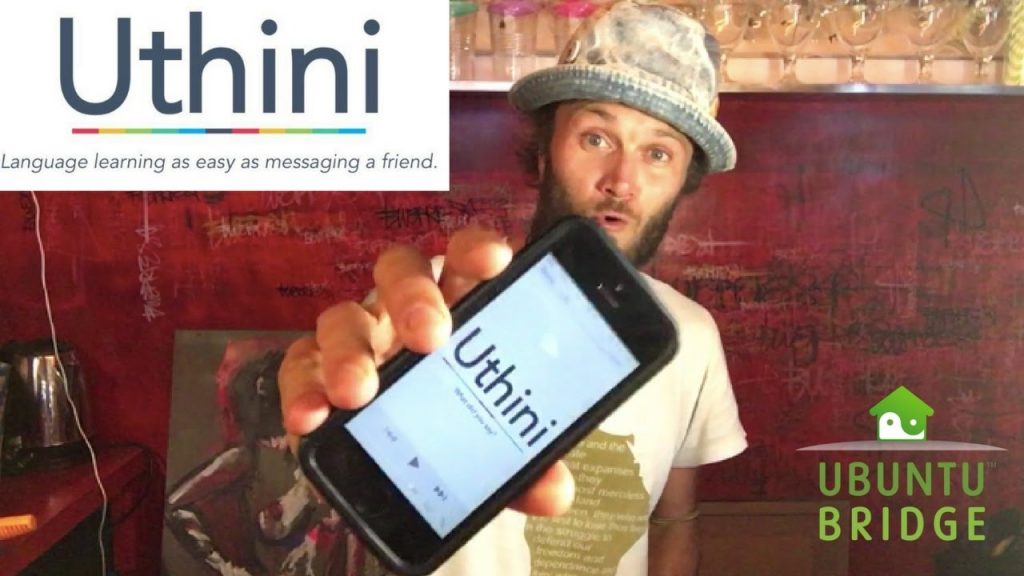
Uthini have partnered with Ubuntu Bridge to deliver content. This ad is from their 2017 pilot

What makes this unique is that the bitesized lessons can easily fit them into you day. The use of a mobile chat platform is intuitive and simple, and means you just need a phone to access it. And the daily exposure helps solidify the learning. The resources are also always available, so you can practice when you have time. And at present they have lessons available in both Xhosa and Zulu. (Bonus: you can access the lessons from wherever you are in the world!)

I took part in their pilot program that launched in January last year. And over that time I got into a great routine and was able to learn some basic Xhosa. I really enjoyed it, and once I’ve handed in my thesis I’m going to sign up for more.

The power of language

Even though Uthini is just over a year old they’ve already made massive strides and have achieved so much. They’re currently part of the Injini Edutech incubator where they have received significant support in the form of funding, mentorship and workspace.

Apart from the innovation in delivery and approach, what really excites me about Uthini is how easy and accessible they’re making it to learn South African languages. There are many people who have begun to recognise how important it is to learn these (especially white South Africans). And the combination of the novel delivery, easy time management and affordability mean that they’re able to really drive learning.

So a massive Friday Shoutout to the team from Uthini, keep up the great work!

(P.S. If you’ve been wanting to learn Xhosa or Zulu but have been making excuses, now is your time to act! Seriously. Go sign up. Here’s the link again in case you’re feeling too lazy to scroll up. Now go! 🙂


Image was taken from a Lions-head hike early this morning. One of the founders of Uthini, Miguel, was part of the hiking group 🙂


Thesis update: focused on my consulting project today
Blog 75/365. Read more about my #365of25 journey here


Subscribe to Blog via Email

Enter your email address to subscribe to this blog and receive notifications of new posts by email.

The Liminal Space

Today a friend of mine told me about the anthropological concept of a “liminal space“. A liminal space is a transitional or initial stage between two positions, states or boundaries. Examples of these include the time between finishing school and starting university, waiting to board a plane at the airport or being between jobs.

In this phase, a person is caught between their old habits/rituals/traditions and the new ones. The way they structure their lives hangs in the balance, waiting for a new order to take place.

Another way to look at would be that a person has moved away from their old personal institutions but has yet to develop new ones.

Navigating the liminal space

I’m undergoing a liminal stage at the moment. I’m about to finish my student life and properly begin my professional one. I’m also suddenly taking on far more responsibility in my personal life. And finally, there are big shifts happening with my friends and family.

Navigating this space is difficult, and I’m still not entirely sure how to do it. Part of the solution is to build temporary habits to tide myself over while maintaining old ones that keep a level of consistency in my life.

It’s an odd space to be in, and the lack of structure makes effective work difficult. It sometimes feels like I don’t know which way is up. But I know I’ll find my new normal soon. Either that’s or I’ll continue floating on through my liminal space 🙂


Image was taken at Cape Town international airport sometime last year.

Thesis update: got some writing done 🙂

Blog 74/365.

Subscribe to Blog via Email

Enter your email address to subscribe to this blog and receive notifications of new posts by email.

Building strong personal institutions

Building “strong institutions” is an important concept in international development theory. For example, goal 16 of the UN Sustainable Development Goals is “Peace, Justice and Strong Institutions” I heard the term in my one of the first seminars of my masters and was quite perplexed by it. From my understanding, institutions were entities such as universities or governments or NGOs.

A quick google search produces the following quote from wikipedia:

Institutions are “stable, valued, recurring patterns of behavior”. As structures or mechanisms of social order, they govern the behaviour of a set of individuals within a given community. Institutions are identified with a social purpose, transcending individuals and intentions by mediating the rules that govern living behavior.[1]

After reading this, it becomes clear that institutions aren’t simply entities. Instead, they are a complex set of behaviours that help maintain stability and keep values consistent. Institutions such as the justice system are vital for keeping a society together.

It makes sense then that countries with strong institutions are more stable and that those with weak institutions are susceptible to corruption, dictatorships and civil wars. The stronger the habits and behaviours of a society, the less likely there will be deviation from them.

Our own personal institutions

We can recognise that strong institutions on a societal level help achieve positive outcomes. This is because they influence the behaviours of the individuals.

However, when we look at our own lives, we often see an individual operating in complete isolation. If we fail to achieve a certain outcome, it is exclusively our fault. If we succeed in doing something, it is mostly attributable to our own work.

An example of this is a friend that has recently moved home and is studying for board exams. She has become incredibly frustrated with herself has not achieved the level of studying she feels she should have. And she hasn’t gotten close to the amount of studying she did while at university.

The reality is, however, that she does not have the same institutions around her anymore. Over the last 5 years at university she had built up strong institutions that guided her studying behaviours and patterns. These may have included the friends she surrounded herself with, the people she lived with, the habit of going to campus everyday and the frequent contact with academic staff.

However, at home, none of these exist. Her behaviours are now governed by an entirely different institution which was not purpose built for studying. In fact, her behaviours there developed over holiday periods when she was most likely to be home. And what results is a much worse pattern of work and much lower output.

It’s not only about you

This friend cannot attribute the poor work level exclusively to herself. In truth, she doesn’t have as much power as she thinks over the situation.

This holds an important lesson. If we start understanding that institutions influence our behaviours, we can start focusing on building them. They can be built permanently, for longer term outcomes, or temporarily, to achieve a specific goal.

Building these can be challenging but it is possible. In this case, they might include scheduling a regular time to go to the library, forming a study group or having a mentor to help guide you through a process.

It is important to recognise that we exist as individuals, but mostly operate as a collective. And that the people, common habits, behaviours and patterns that we surround ourselves with will ultimately influence our outcomes more than we realise.

We must focus on developing ourselves as individuals. But we must also make sure that we develop our personal institutions. It is the combination of both that will ultimately determine what we achieve


Image was taken in February 2016 outside South African parliament. As finalist in the Nedbank/Old Mutual Economics Essay Competitions we got to go into parliament to watch the Budget Speech.

Thesis update: submitted progress report, got intention to submit sorted
Blog 73/365. Read more about my #365of25 journey here


Subscribe to Blog via Email

Enter your email address to subscribe to this blog and receive notifications of new posts by email.

Learning the key life skills

In South Africa we have a subject called “Life Orientation” (LO) as part of our high school education. The syllabus aims to educate in basic life skills and consists of learning about various religions, STDs/sex ed, alcohol, career guidance etc.

I had a great teacher for LO, which made the experience quite enjoyable. However, the majority of South African learners do not see any value in it, and implementation is generally quite poor (Jacobs, 2011).

I think that the idea of the subject is great, but that there are so many skills that could be taught as part of the syllabus. Off the top of my head these include:

  • Applying for government documentation (IDs, drivers, passports)
  • Understanding medical aids and the health system in general
  • How to file taxes
  • Basic meal preparation and other home management techniques
  • Understanding employment contracts and the rights of employees
  • Understanding and managing mental health problems

There is much more that can go into this list. The idea, though, is that LO could be used as a vehicle to teach essential life skills. In doing so, it would make it easier for young adults to function in the real world.


Image is of my little brother at my old school, taken in 2011. He starts high school tomorrow! Good luck kiddo!

Thesis update: got serious food poisoning today. Spent the day in bed
Blog 72/365. Read more about my #365of25 journey here


Subscribe to Blog via Email

Enter your email address to subscribe to this blog and receive notifications of new posts by email.