Rowan Spazzoli

Strategist. Lecturer. Consultant

Meditating out a rut

I find that meditation is one of the best ways to get out a rut. It is also one of my most under-utilised.

This morning I struggled to gain momentum. I was feeling heavy from things that had happened over the last few days. I’d also slept badly and had some really weird dreams.

And these thoughts and feelings were following me around as if they were tied to my ankle

I took some time to meditate. And in doing so, I was able to remove the weight. And be more in the moment.

It’s hard to get yourself to pause and realise that your baggage is unnecessary. But once you’re able to, it’s quite liberating.


Image is of our bonsai plant in our living room 🙂

Blog: 205/365

Song of the day: The Next Episode – Dr Dre

Planning with the monkey

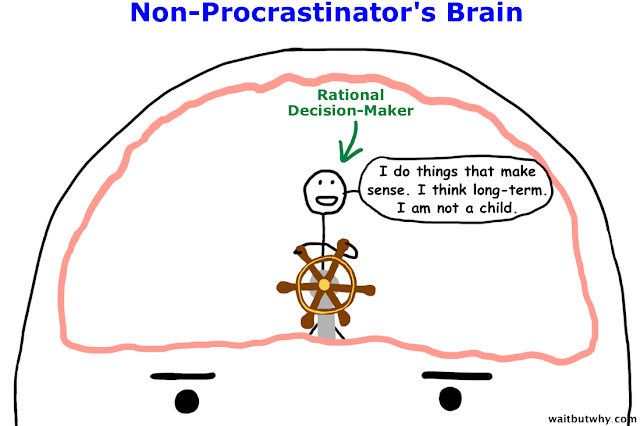
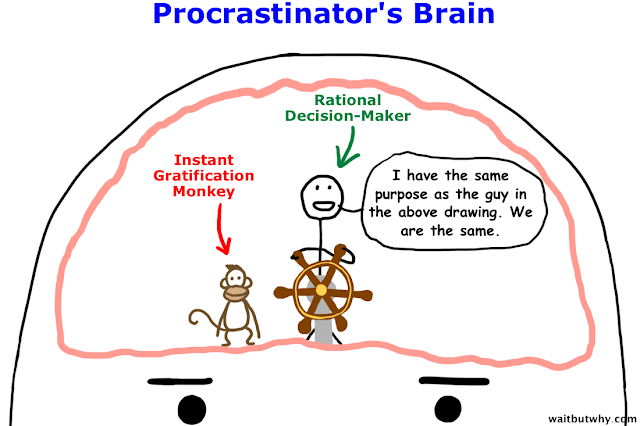
One of my favourite blog posts of all time is Why Procrastinators Procrastinate by Tim Urban. In it, he describes two different “brains”, one of the procrastinator, which looks like this:

NP brain

And the brain of the non-procrastinator, which looks like this:

P brain

As you can see, the main difference between the two is the instant gratification monkey. This monkey derails the rational decision maker constantly. He directs the procrastinator to seek food (even if he’s not hungry), meander through the internet, take naps and clean the house. All of this instead of working.

My brain looks like the procrastinators brain. Except the monkey is not a cute, innocent looking creature. I have an instant gratification gorilla called Dave and he is very prepared to beat the daylights out of my rational decision making side as often as possible.

black gorilla closed up photography

Actual picture of Dave, ready to ruin my day (Photo by Pixabay) 

So Dave is regularly able to derail my day. But it’s okay, I’m usually able to recover some productivity. And on deadline days, Dave lets me have an extra bit of time as long as I feed him properly.

A week with no Dave

Dave and I have gotten quite good at living together. However, I have a major problem:

I never take into account that Dave will still be around tomorrow, next week or next month

For example, I’ve said to myself that next week I have no appointments for anything. So I’ll be able to put in at least 50 hours of work. Which would be fine, if Dave didn’t exist.

But he does.

And so I will get some work done.

And Dave will take his share of time too.

I did the same thing with this week. I estimated the amount of time I would have to work based on the idea that I would be completely rational and able to stay focused for an outrageous amount of time.  And I do the same with most of my work.

When I then get to the time that has been planned, I realise that Dave is still around. And I’m sent into a panic when I try and achieve maximum output when, in fact, I have a giant gorilla distracting me.

What are you on about Rowan?

Hold your horses (and monkeys), there’s a point to this.

When I plan my life and time, I do so with the maximum objectives in mind. As if all my time is spent optimally and there are no hiccups along the way. And 99 times out of 100, there will be something that sets me off course. Whether it’s internal, with my instant gratification gorilla distracting me, or external, with my stuff being stolen

This makes me feel like I’m consistently not living up to my expectations. As if I’m failing, again and again.

But I’m not.

I’m actually just plodding along at normal Rowan pace. Though my expectations are set way above that. So I feel as if they are constantly being missed.

I try to plan my life as if there is no Dave. But I should plan it with the active recognition that he is around. That he will be here tomorrow, next week and next month. Therefore I can continue to fight him (and lose) or I can accept that he is going to be here and make room for him.

I should plan for a distraction. For tiredness. For unexpected events.

I need to plan with Dave. Set up time to drift off, allow for naps and the odd derailment.

And in doing this, I’ll set more reasonable and achievable expectations for myself. Allowing me to be less on edge and allowing Dave the play time he needs.


Image was taken at Cape Point a few weeks ago. I’ve uploaded a different picture of this guy before, but I’m still upset he stole our Doritos

Blog: 204/365

Song of the day:  Fin Evans – Never Forget You (Feat. Alex Foster)

New ideas, everyday

A few weeks ago I read a blog by Seth Godin where he said he was completely out of ideas. After 16 years of blogging and over 8000 original posts, he had finally gone dry. The barrel was empty.

This struck a cord with me. I was only 170 posts in and I was starting to feel like I was running low on ideas. All the deep insights I had seemed to been used. Sometimes it felt like I was just rewording old ideas.

Maybe I only had around 150 ideas and they had been spent?

It was only  later, in a follow up blog, that Seth revealed it had been an April fools joke:

And today, give or take, is the sixteenth anniversary of this blog. Not quite on April Fool’s Day a bunch of years ago, but close enough. I feel badly that so many people were fooled by this morning’s post, and I’m grateful to those that wrote in with concern. But no, I was making a point, not telling the truth. It turns out that showing up is a great way to find new ideas, and I have no plans on stopping.

Despite knowing that it was light prank, it has played on my mind quite often. There are some nights that I just sit at the computer screen, not knowing where to start. And others where I’ll write a post, only to realize I wrote a similar one a few months before.

This was again brought to my attention today when a comment on my blog today said that it appeared I may be getting bored.

I thought about this and came to the conclusion that I wasn’t bored. I’ve been really enjoying my blogs over the past while.

Instead, I have run out of ideas. I’ve run out of my well formed ideas.

  • The ideas you spend years thinking of.
  • The ideas that you carry with you through different stages of your life.
  • The ideas that you have convinced yourself are absolutely true.

And now, I’ve started entering unfamiliar territory. A place where I have to conceive new ideas, challenge them and leave them open to scrutiny.

Where they haven’t had years to form. Where they might have gaps. And where I might not fully understand them.

It’s the next phase of my blogging and development. More rapid idea formation and more letting myself go.

I’m not out of ideas.

I’m just learning how to come up with them more quickly.


Image was taken in 2006, and this is a picture of that picture (I can’t find the original). The three brothers are in the picture, with Fabio looking how I feel at the end of the day

Blog: 202/365

Song of the day: Don’t stop me now – Queen

Right where I want to be

I’m absolutely exhausted and have been struggling to find the energy to write my blog post. So instead of writing anything insightful, I’d just like to take a moment to appreciate where I am right now with regards to my work/professional life.

Today I worked in four areas:

  • Behavioural economics and psychology
  • Teaching strategic thinking (applied to development outcomes)
  • Market analysis and strategy formulation for green economic development in Cape Town
  • Social entrepreneurship

The first was done in relation to my thesis. Despite it not being quite finished yet, some of my preliminary results will be presented at a conference on Monday.

The second was done at UCT when we met to plan the exam for this semester. It’s going to be an incredibly interesting exam.

The third was in relation to my consulting work on my green economic development project.

The last area was assisting with the submissions for the Oxford “Map the System” challenge. I’m the organizer of the South African leg of the competition.

I honestly am in awe of how fortunate I am to be working on all these exciting projects at the same time. I’m exactly where I want to be and I couldn’t be happier 🙂


Image was taken at Babylonstoren a few weeks ago 🙂

Song of the day: The Quiet - Roald Velden
Blog 159/365. Read more about my #365of25 journey here

Drawing the strings together

At this point in my thesis I’ve collected and crafted a bunch of strings. Tiny components that will make up the finished document.

They’re in the form of literature, data, results and analysis.

And now I’m bringing those strings together. Weaving them, tying them, threading them.

It’s an exhausting process. But it’s starting to take shape.

And I can’t wait to have the final product.


Image was taken during my bike ride on the prom today 🙂


Song of the day: Kirin J Callinan - Big Enough ft. Alex Cameron et.al
Note: watch until 2:30 for a treat ;)
Thesis update: had a rocking day :) lots of ground covered
Blog 91/365. Read more about my #365of25 journey here


Subscribe to Blog via Email

Enter your email address to subscribe to this blog and receive notifications of new posts by email.

Lecturing Lessons #1

This week I’ll be traveling to Pretoria for my consulting work. It’s going to be quite difficult write full blog posts over that time. So for the next few days I’ll be sharing some tips and lessons I’ve learnt from teaching at UCT. I’ve taught as a tutor, an assistant lecturer and as a lecturer for 4 years. It’s been an incredible journey and I know that this is only the start.

Lecturing Lesson #1: Names

When I used to tutor there would be 30 or 40 students at a time, and I’d usually have two or three classes. And in the strategic thinking course there are around 500 students in total.

Learning names is quite a daunting task. And it’s really easy to get by without learning them. No one expects you to know their name.

But I find it’s one of the easiest ways to connect with students. As soon as you know their names, they tend to be more responsive and attentive, which makes teaching easier.

Obviously I sometimes forget names, but I’ve got two sneaky techniques if I do:

  1. Check the online portal– it might take a bit of scrolling, but all their names and pictures are available on the course tab
  2. Get them to send me an email– promise to follow up if they send an email and then you have their name on record

Again, knowing someone’s name is nothing extraordinary. But in a sea of people, when you’re sometimes just reduced to a student number, it can really make a difference


Image is from the finals of the Oxford Global Challenge in the Nelson Mandela Lecture Theatre at the Saïd Business School

Song of the day: Gorgeous- Taylor Swift
Thesis update: Took the day off :)
Blog 83/365.Read more about my #365of25 journey here

Subscribe to Blog via Email

Enter your email address to subscribe to this blog and receive notifications of new posts by email.

The gulf between “Policy” and “Action” and why it matters

Ever notice how politicians say stuff that doesn’t match up to what’s happening on the ground? Or how institutions will draw up an elaborate policy that seems to lead absolutely nowhere?

An interesting way to understand this by using the Rumelt framework, which is one of the tools we teach in the Strategic Thinking course at UCT . It comes from Richard Rumelt’s book “Good Strategy, Bad Strategy”, where it is referred to as the “kernel” of a good strategy. The framework breaks an effective strategy into three components:

  • Diagnose: a good diagnosis provides a comprehensive understanding of the nature of the problem that needs to be addressed
  • Guiding Policy: this outlines the person/organisation’s overarching approach to the issue. It’s helps direct the steps that are then taken.
  • Coherent Action: a coherent set of actions are ones that flow from the guiding policy and diagnosis. They target the issue/goal directly and are effective in doing so. As stated in the book, “resource deployments, policies and manoeuvres that are undertaken should be consistent and coordinated

Now, there are a number of ways that organisations get this wrong. I’m going to demonstrate this with two examples from my alma mater, UCT.

Example #1: Water Policy at the University of Cape Town

As we all know, Cape Town is in the middle of a water crisis and we are very close to running out. Everyone is trying to do their bit to save water, and it appears that UCT are trying too. The University has sent out a numerous emails, put up massive banners all over campus and tried to engage in the conversation around the issue.

However, these actions are baseless fluff when you look at what’s happening on the ground. For example, there is a really easy way to save water in men’s bathrooms. Urinals can be fitted with something like the Lilydome waterless valve which would save between 130 000 and 200 000 litres of water per year per urinal. 

But at present, almost all urinals on UCT upper campus use water instead of a system such as this. Even if we conservatively estimate that there are 100 urinals on campus, installing these would mean saving between 13 and 20 million litres a year.

Another measure that has been employed at the Graduate School of Business (which functions separately to the main UCT campus) is that the taps in the bathroom have been turned off and hand sanitisers installed in their place. They’ve also got Lilydomes installed in all their urinals. In this way, the male bathrooms have been made almost entirely waterless, with the exception of the toilets.

So let’s look at the UCT Water Policy using the Rumelt framework:

  • Diagnosis: we need to save water
    • Good. We’re all on board with this.
  • Guiding Policy: reduce water consumption as much as possible around our campuses
    • Still good. That sounds like a great policy to have
  • Coherent Action: lots of emails. And giant banners. Lots of giant banners. And opinion pieces on our website and in every news source we can get our name into
    • And here is where it falls apart. Their actions make it seem like they’re trying to do something. In reality, their impact would only be felt through the awareness they raise. It’s not wrong. But there are much more effective ways of reducing water usage at the University.

We could craft a simple coherent action using the Lilydome example. Each of the banners that UCT printed probably cost around R2000. I’ve seen 4 of them. Each Lilydome costs around R400. So instead of spending R8000 on 4 posters, spend it on 20 Lilydomes. And that single , coherent action would save 2.6mil – 4mil litres per year. Done.

Example #2: Mental Health Policy at the University of Cape Town

This is a more complex and sensitive subject. It is in need of serious attention at UCT, and I won’t be able to go into it in detail. But here is brief an analysis of what took place in 2017 in terms of the Rumelt Framework.

Last year, after pressure from students and in light of a number of suicides UCT spent around 8 months developing a Mental Health Policy. A task team was set up, numerous meetings were held, and information about it was included in the newsletters. At the end of December a draft policy was published on the website.

While this was happening, an article came out on the UCT about a student who had invented an innovative grey water system for households. The opening line of the article described how he was unable to register at UCT in 2017 due to a lack of funds. In other words, UCT had financially excluded him but still wanted to take the credit for his water saving system (see example #1 above).

Two months later, this student was found dead after “falling” from the top floor of a building. The investigation is ongoing, and it may or may not have been suicide.

However, there were 6 deaths of this nature in 2017. Some have been declared as suicides, some are still under investigation.

And this is where the problem lies. UCT spent 8 months and a significant portion of their resources in coming up with a mental health policy. And while they were sitting in their offices doing so, the situation kept getting worse on the ground.

Let’s look at this in terms of the Rumelt framework:

  • Diagnosis: there is a high suicide rate (and we’re under pressure about it)
    • This is a problem but it’s not the correct diagnosis. A proper diagnosis would involve going onto the ground and understanding why this is the case. And doing this doesn’t just involve holding open meetings on campus. It means going and finding students, talking to them and discerning the nature of the problem. The actual problems may lie in insufficient academic support, a shortage of funds or lack of mental health resources available (i.e. it can take months to get a booking for a psychologist at UCT)
  • Guiding Policy: get together a task team that may have little connection to the students. Have meetings. Host open feedback sessions. Develop 17 page policy
    • A proper guiding policy should be simple and show intent. The UCT mental health policy does not do this. So much of it is definitions and empty, fluffy statements. Instead, a policy could be something as simple as “Assist students with the financial, administrative and systematic support across academic, residential and student wellness services.” Done.
  • Action: send out the policy in an email. Get it put in the news. Share phone numbers
    • Look, I’m sure the policy outlines some important stuff. But ultimately, students are in the same position as they were before. The policy is based on a poor diagnosis of the problem and there are very few tangible, coherent actions. An example of an action might be to have a system that identifies students have been financially/academically excluded and assign a councillor to them. Or to provide more resources to the Student Wellness Centre.

The UCT mental health policy is not all bad. It shows intent from the university and has some provisions that may help. My concern is that there are better ways to craft a strategy to address the issue. The university needs to understand the problem better, make their policy clear (it doesn’t have to be a 20 page document) and follow through with coherent well thought through actions. A bureaucratic approach won’t help, we need to get on the ground to fix it.

Connecting our diagnosis, policy and action

Developing a strategy to address an issue is a difficult task, particularly when resources to do so are stretched thin and the issue is complex. However, it is important to make sure that the resources you do have go effectively into solving the problem. Raising awareness is fine, but it amounts to meaningless fluff if there is no proper set of actions in place to solve it.

I’ve used UCT as an example but this is the case at many institutions and organisations around the world. We can do better with how we fix problems. We just need to spend a little more time on our strategies, instead of trying to make it appear to the outside world like we’re doing something.

Ultimately, by developing an effective strategy that with a proper diagnosis, a good guiding policy and coherent set of actions we will be far more effective in solving our issues.


Image is of a poster on upper campus UCT. There were a number of these hung up over campus. Instead of spending money on these, UCT could have developed actual, coherent actions

Song of the day: Andrew Rayel - Miracles
Thesis update: did a large volume of data work and got in a bit of a tangle
Blog 80/365. Read more about my #365of25 journey here


Subscribe to Blog via Email

Enter your email address to subscribe to this blog and receive notifications of new posts by email.

The Friday Shoutout: Uthini

Today I’m starting a new instalment on my blog titled “The Friday Shoutout.” Each week I’ll be highlighting an interesting/awesome person, business or project that I’ve come across. The idea is to spread the word about the exciting things going on the fields of development, entrepreneurship, education, economics, strategy and beyond. If one of the Friday shoutouts catches your attention, send me an email and I’ll connect you with them 🙂

My first Friday Shoutout goes to Uthini, an edutech startup based in Cape Town

Uthini

Uthini is an exciting new startup that is making it easier to learn South African languages. Their teaching is done through the Telegram messaging platform (similar to Whatsapp), where a bot and live tutor guide you through the content. Lessons are 15min long and scheduled daily at a time that suit you. They use a combination of videos, text, gifs and voice notes to deliver the content and the tutor gives you feedback in real time.

Uthini have partnered with Ubuntu Bridge to deliver content. This ad is from their 2017 pilot

What makes this unique is that the bitesized lessons can easily fit them into you day. The use of a mobile chat platform is intuitive and simple, and means you just need a phone to access it. And the daily exposure helps solidify the learning. The resources are also always available, so you can practice when you have time. And at present they have lessons available in both Xhosa and Zulu. (Bonus: you can access the lessons from wherever you are in the world!)

I took part in their pilot program that launched in January last year. And over that time I got into a great routine and was able to learn some basic Xhosa. I really enjoyed it, and once I’ve handed in my thesis I’m going to sign up for more.

The power of language

Even though Uthini is just over a year old they’ve already made massive strides and have achieved so much. They’re currently part of the Injini Edutech incubator where they have received significant support in the form of funding, mentorship and workspace.

Apart from the innovation in delivery and approach, what really excites me about Uthini is how easy and accessible they’re making it to learn South African languages. There are many people who have begun to recognise how important it is to learn these (especially white South Africans). And the combination of the novel delivery, easy time management and affordability mean that they’re able to really drive learning.

So a massive Friday Shoutout to the team from Uthini, keep up the great work!

(P.S. If you’ve been wanting to learn Xhosa or Zulu but have been making excuses, now is your time to act! Seriously. Go sign up. Here’s the link again in case you’re feeling too lazy to scroll up. Now go! 🙂


Image was taken from a Lions-head hike early this morning. One of the founders of Uthini, Miguel, was part of the hiking group 🙂


Thesis update: focused on my consulting project today
Blog 75/365. Read more about my #365of25 journey here


Subscribe to Blog via Email

Enter your email address to subscribe to this blog and receive notifications of new posts by email.